Merafe Resources Limited
INTEGRATED ANNUAL REPORT
2025
Delivering today. Investing in tomorrow.
1/3
The Venture's ferrochrome operations remain under pressure, with only the Lion smelter back in operation following the successful recommissioning of 50% of its operating capacity in February 2026.

We recorded no fatalities for the year 2025. Our TRIFR decreased from 2.31 to 1.79, an improvement rate of 23%. The safety of our employees remains our top priority. We are committed to continuously improving our safety performance, focusing on the four key areas identified in our turnaround strategy: risk management, effective supervision, safety culture, and contractor management.
In 2025, two cases of occupational disease, namely Noise‑Induced Hearing Loss (NIHL), were recorded at Rustenburg and Helena mines. The case at Helena mine was reported in the last six months of 2025. Employees are issued with customised Hearing Protection Devices (HPDs), and reducing exposure at the source remains our priority.
The Venture's commitment to creating a healthy work environment remains steadfast. We will continue promoting not only the health and safety of our workers but also the wellbeing of the communities in which we operate.
Our approach goes beyond the workplace, recognising that a healthy community supports a thriving workforce. Through proactive health initiatives, partnerships with local organisations and sustainable practices, we have and will continue to create lasting, positive impacts that extend far beyond our facilities.
We will review all health risk assessments on an annual basis as required by the Venture's Health Standard and applicable legislation, and maintain our pre-, annual and exit medical surveillance to monitor the occupational health of our workforce. Implementing our Health Standards and Glencore Exposure Limits is a core strategic focus, integrated with our baseline review to confirm exposures through quantitative data analysis.
Environmental, social and governance (ESG) compliance is a fundamental pillar of our business operations. We foster strong relationships with employees, suppliers, customers and communities by promoting fair labour practices, employee rights and a commitment to diversity, equity and inclusion.
Despite financial challenges, we remained unwavering in our commitment to invest in our communities. As a result, our social impact has deepened, reflecting our dedication to both people and the places we serve.
Our efforts spanned infrastructure development, raising awareness of social issues, creating procurement opportunities, and supporting small businesses within our host communities. By insourcing our local business hubs, we continue to strengthen and empower local small, medium and micro enterprises (SMMEs).
Collaborations with local mines, government, and the South African Police Service (SAPS) proved successful in driving awareness of Gender-Based Violence. On World Aids Day, we partnered once again to host a sports day, using the platform to highlight the ongoing fight against the pandemic. We also advanced education through our learner incubation programme, with a strong focus on STEM subjects.
Women in Mining, in partnership with corporate social responsibility (CSR), mobilised employees to donate cash or sanitary towels, resulting in over 20 000 sanitary towels distributed to host communities, addressing a critical need and supporting community wellbeing.
Notably, despite financial constraints, we successfully completed and officially hasnded over 11 Corporate Social Investment (CSI) ad hoc capital projects, an achievement that underscores our resilience and commitment to meaningful community development.
As a member of the International Council on Mining and Metals, the Venture adheres to the mining principles, which include 10 sustainable development principles and eight position statements covering issues from biodiversity to water management. We recorded no major or catastrophic environmental incidents in the reporting period. We have completed the assessment of material water-stress risks and set local water targets, implementing actions to reduce impacts and improve performance against these targets. Additionally, we have embarked on a project to visualise our knowledge base using geographic information system solutions to support decision-making processes.
We are committed to delivering our scope 1, 2 and 3 industrial emissions targets: a 15% reduction by the end of 2026, a 25% reduction by the end of 2030 and a 50% reduction by the end of 2035 against a 2019 baseline, with a longer-term ambition of achieving net zero industrial emissions by the end of 2050.
Merafe's profits declined drastically to R143 million due to lower ferrochrome volumes sold, stronger ZAR:USD exchange rates and higher cost of ferrochrome production. Ferrochrome volumes sold were impacted by the suspension of smelters in response to adverse market conditions. Chrome ore and PGM volumes sold, as well as PGM prices were higher, contributing positively to revenues.
Merafe's attributable ferrochrome production decreased from 301kt in 2024 to 112kt for the year ended 31 December 2025. The total unit cost of ferrochrome production increased 14% year-on-year. The increase was driven by significantly higher standing charges which were offset by lower reductant, power and chrome ore costs. Saleable chrome ore produced at the mines in 2025 was 4% higher than in 2024 mainly due higher yields. Lower tonnages (16%) at the UG2 operations were mainly due to lower feed and dispatches. Production costs for mines were 6% more than the prior year, mainly due to lower volumes produced, lower yields and above inflationary increases. Production costs from the UG2 platinum tailings were 2% higher than the prior year, mainly due to lower volumes, which were offset by lower prices paid for raw material from PGMs producers (linked to chrome ore market prices). Saleable PGM production increased from 13 557oz to 14 948oz as a result of the inclusion of the PGMX plant for the full year and improved yields.
During 2025, the logistics environment was shaped primarily by weaker global ferrochrome market conditions rather than infrastructure constraints alone. Reduced competitiveness and lower demand in the first half of the year resulted in temporary production curtailments across the ferrochrome sector, leading to lower export volumes.
As market conditions changed in the second half, particularly in relation to chrome ore, export demand recovered and required a rapid step-up in logistics capacity. The Venture responded by flexing its transport mix and export planning to accommodate the higher volumes efficiently.
Rail reform initiatives continued to progress during the year, providing greater clarity on future network structure and access opportunities. Incremental improvements in rail performance, together with targeted focus on key corridors, supported improved reliability and throughput during the recovery period.
Despite a volatile demand profile and ongoing structural constraints across the national rail and port system, the Venture maintained stable export flows and met its shipment targets through proactive logistics management, early vessel planning and close coordination with rail and port stakeholders.
The supply of electricity has improved greatly in 2025, with minimal load curtailment. However, the rising costs of electricity remain a concern and pose an existential risk to the South African ferrochrome industry (the industry).
High electricity costs are the key contributor to the Venture's decision to suspend all operating smelters in Q2 2025, post the business review.
While the NPA provided relief and certainty on tariff increases, it was not sufficient to make South African smelters competitive.
The Venture commenced the consultation process in terms of s189 and 189A of the Labour Relations Act on 1 September 2025.
The consultation process commenced after engagements with the government did not identify viable options to address challenges impacting the Venture's ferrochrome operations, with the most pressing being the provision of a competitive electricity tariff.
In December 2025, the Venture signed a Memorandum of Understanding (MOU) with Eskom to extend collaboration and engagement to find a workable energy solution by 28 February 2026. This MOU meant that the agreed termination date would be extended from 31 December 2025 to 28 February 2026 and the Venture would continue paying salaries until 28 February 2026.
In January 2026, NERSA approved a 12-month interim tariff of 87.74c/kWh. However, the interim tariff is not enough to restart all suspended smelters which require a tariff of 62c/kWh. On 27 February 2026, in-principle support for the proposed 62c/ kWh electricity tariff (Proposed Tariff) was received from Eskom and the South African government (Government). Specific terms and conditions of the Proposed Tariff are critical and engagements with Eskom and Government continue. In good faith, the Venture has extended the current termination date under s189 and 189A of the Labour Relations Act, 66 of 1995, consultation process from 28 February 2026 to 31 March 2026.
Project Phoenix, the business restructuring, streamlining and right-sizing project, was unaffected and continued as planned.
Global stainless-steel output increased by 2.2%1 in 2025, reaching 65.4Mt1. Growth was primarily driven by China, where production rose by 2.6%1 year-on-year.
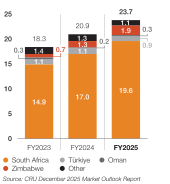
Global ferrochrome output outside China declined by approximately 21%1 year-on-year, with production contracting across most regions. The most pronounced reduction occurred in South Africa, where output decreased by approximately 50%1 year-on-year.
By contrast, ferrochrome output in China increased by more than 6%1 to approximately 9.5Mt1 in 2025, representing around 60%1 of global supply. The commissioning and higher utilisation of lower-cost smelting capacity, particularly in the second half of the year, supported this increase and displaced higher-cost producers.
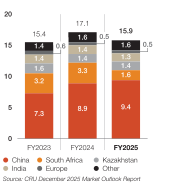
South African global chrome ore exports increased by 16%2 year-on-year to 23.8Mt2. Prices remained at elevated levels throughout the year, supported by strong demand growth from China.
1 CRU Data.
2 SARS Data.
As part of the Venture's strategy to ensure stable and consistent supply at optimal cost of electricity to the operations, both offsite and onsite projects are being pursued.
Offsite: Financial close was reached in 2024 for the Sonvanger Solar plant, a 100MW facility located near Theunissen in the Free State Province. However, due to uncertainty surrounding the Venture's smelting operations, the Venture has initiated processes to de-risk the project.
The Venture's ferrochrome operations remain under pressure, with only the Lion smelter back in operation following the successful recommissioning of 50% of its operating capacity in February 2026.
While the interim tariff of 87.74c per kWh enables Lion smelter to return to operation in the short term, it unfortunately remains insufficient for it to operate sustainably over the long term. The same applies to Boshoek and Wonderkop smelters. All three operations would require a tariff of 62c per kWh, to operate on a commercially viable basis over the long term.
This requires us to shift focus to chrome ore and PGM operations, while trying to find sustainable solutions to uncompetitive electricity tariffs.
We continue to focus on maximising cashflows from the Venture and evaluating growth.
Global stainless steel production is expected to grow at similar levels to 2025, which should support growth in ferrochrome demand. However, with South African output expected to remain under pressure, it is likely that the market will be in deficit for the short to medium term.
We remain committed to creating shared value for our stakeholders.
Zanele Matlala
Chief Executive Officer
6 March 2026
Global stainless steel production (Mt)
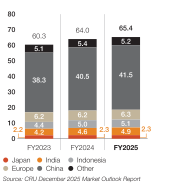
Global stainless steel production (%)

Global ferrochrome demand (Mt)

Global ferrochrome demand (%)
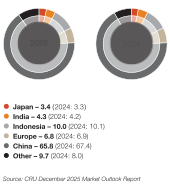
Global ferrochrome production (Mt)
UG2 merchant prices (USD/t)

Chrome ore imports into China (Mt)
| Note: |
The source of information here in this report is CRU. This market information is continually updated by CRU. Such updates may amend previous information or projections. To the extent that there is any significant or material change to information provided by CRU and used in this or previous reports then this will be stated. |
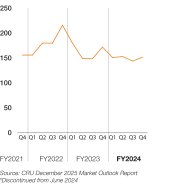
European ferrochrome benchmark price# (USc/lb)