Merafe Resources Limited
INTEGRATED ANNUAL REPORT
2025
Delivering today. Investing in tomorrow.
The Venture believes in the possibility of a zero-harm operation. We believe that all occupational diseases and injuries can be prevented and that we must therefore take responsibility to avoid occupational diseases and injuries. The development and wellbeing of our employees is a core value of the Venture.
This section of the report covers the following areas:
 Human
capital focus areas
Human
capital focus areas
We need a healthy, motivated and skilled workforce. Intellectual capital and knowledge management are also recognised as key intangible creators of wealth. Damaging human capital by abuse of human rights or labour rights or compromising health and safety has financial and reputational costs.
The Venture enhances its human capital by:
Stakeholder impact and engagement with stakeholders
Fatalities
None
(2024: 1)DISR
103
(2024: 76.96)The Venture had
no safety and health penalties
in 2025TRIFR
1.79
(2024: 2.31)LTIFR
1.2
(2024: 0.80)| * | Merafe's attributable portion of the quantitative data of the Venture set out in the manufactured, natural, human and social capital sections and stakeholder responsiveness of this report is 20.5%. |
The Venture's operations maintain stringent safety and risk management systems, which align with the international standards: ISO 45001 and ISO 31000. Glencore collates best practice from each of its assets and from externally recognised leaders in safety management, and shares this knowledge across the Glencore Group. Through Glencore, all the operations of the Venture are members of the International Council of Minerals and Mining.
The Venture takes a proactive and preventative approach toward safety, aiming to instil a positive safety culture in which everyone fully integrates its safety values into their working lives. It reviewed its approach to safety by updating its risk management framework. Glencore's Fatal Hazard Protocols and high-potential risk incident reporting processes have been rolled out in the Venture. There are weekly meetings and discussions around the reporting of high-potential risk incidents.
Glencore's Chief HSE Officer is responsible for safety, health and wellness.
| Objective | Supporting actions |
| Zero fatalities |
We reviewed and strengthened our incident investigation process to include 24-hour notification of senior management and the Glencore corporate sustainability team for fatal incidents, and launched a mandatory onsite fatality investigation process following any fatal incident. The Venture's senior management must then report to the Glencore Board HSEC Committee on fatalities and the subsequent independent investigations in person. Any lessons learned that could further improve general fatality prevention are shared across the Group. We ensure independent third-party assistance is onsite within 72 hours of a fatal incident. We developed SAFEWORK, a Group initiative to foster a safety culture based on behaviours and consequences at all levels. We maintain Fatal Hazard Protocols and safety standards (which are reviewed annually) and life-saving behaviours (part of the SAFEWORK programme) across the Group. |
| Reduction of TRIFR |
The Venture focused on reducing the TRIFR. The supporting actions resulted in the TRIFR reducing from 2.31 (2010 baseline) to 1.79 in 2025. |
The Glencore Fatal Hazard Protocols and Life Saving Behaviours, which provide a set of tools that are initially focused on the fatal risks, are being rolled out in the Venture as part of SAFEWORK.
The life-saving behaviours are aimed at strengthening the focus in the Venture on behaviours and consequences rather than a rules-based culture. The fatal risk categories that Glencore has identified as being most hazardous and responsible for the majority of its fatalities include: energy isolation, working at heights, mobile equipment, ground/strata failure, confined space and electrical safety. Over and above this, the Venture specifically highlights people-vehicle interaction as a key danger area.
In 2025, there were 40 (2024: 55) recorded injuries in a workforce of 9 877 (including contractors). An in-depth analysis by the Venture revealed that no single factor stood out in 2025, but that “at-risk behaviour” remains a major problem. As safety is the number one priority in the Venture, a number of campaigns were rolled out and re-emphasised including SAFEWORK, Life Saving Behaviours and SafeWork coaching.
The Venture implemented the Fatal Hazard Protocols in 2015 and continually implements positive reinforcement programmes.
Accountability
Safety in the Venture is always the direct responsibility of Glencore's senior management, who provide the leadership, systems and processes for the prevention of incidents and the elimination of fatalities in the Venture.
The formal management structure documents responsibility for safety from the Glencore Board down to each Venture employee and contractor.
The Venture puts considerable effort into embedding a safety culture in its operations. Its leaders are aware that they are expected to put safety before production or other considerations and to personally endorse safety initiatives and engage with employees at all levels to discuss safety issues and priorities. It concludes health and safety agreements with the trade unions.
The Venture's sustainable development policies are aligned with the Glencore Group Sustainable Development Standards. They set out its commitment to zero injuries and fatalities.
The role of training
The Venture's investment in safety training is detailed in the human capital section of this report. It continues to use virtual reality training, combined with easy-to-read written instructions, on all its different procedures. The training is designed to ensure that employees cannot complete their training on a procedure until they have shown they fully understand it. Training, as can be seen from the detail below this report, was a major focus during the year. Focus for 2025 was again on supervisory development training, ensuring that all supervisors understood their legal responsibility, life-saving behaviours, Fatal Hazard Protocols and critical controls.
Human capital includes health, safety, knowledge, skills, intellectual outputs, motivation and the capacity for relationships of individuals.
NIHL
Two
Employees who test positive for HIV are encouraged to register for treatment
Employees receive HIV and Aids counselling, care and support free of charge
Health programmes at the Venture aim to eliminate occupational illness
Organisations depend on individuals to function. They need a healthy, motivated and skilled workforce. Intellectual capital and knowledge management are also recognised as key intangible creators of wealth. Damaging human capital by abuse of human rights, labour rights or compromising health and safety has direct as well as reputational costs.
We enhance our human capital by providing healthcare, training and education in health matters.
A business needs a healthy workforce that is able to work at its full potential. The health programmes provided by the Venture aim to eliminate and address occupational illnesses, public health issues and the overall wellbeing of its employees and contractors.
Typically, occupational illnesses such as NIHL are only diagnosed sometime after the event that caused them. As a result, the occupational illnesses currently occurring in the Venture’s operations are usually the result of historic mining and smelting practices.
The Venture has identified NIHL as a major occupational health risk for its employees and has employed a full-time audiologist to counteract this risk. Any of its workers exposed to the internationally accepted noise level limit of 85 decibels or above were issued with personalised noise clippers for hearing protection. The equipment it provides includes variphones/noise clippers, which are custom-made for comfort and are 100% leak tight.
Employees are trained in the use, maintenance, storage and care of this equipment. Any employees or contractors at risk of being exposed to noise that could damage their hearing are personally monitored and regularly tested as part of our hearing conservation programmes.
Wherever possible, the Venture reduces the noise from the equipment it uses in its operations to levels below the internationally recommended standards using design modifications, exclusive zones and “buy quiet” programmes for new or upgraded equipment. The Venture’s operations have reduced machinery noise to less than 110 decibels. There were two occupational diseases reported in 2025 (2024: zero). The Venture also monitors potential occupational disease care reported.
All the Venture’s operations undergo an annual risk assessment of their baseline risks, and legal audits are conducted by an external legal company, accompanied by subject matter specialists in a three-year cycle.
HIV and Aids are a human rights issue, which Merafe and the Venture address through their policies and programmes. To ensure these policies are accessible to the Venture’s employees and contractors, they are available in all languages spoken by its employees.
Employees can choose to receive HIV and Aids counselling, care and support. Any HIV-positive employees of the Venture can receive treatment free of charge, together with the support and education that will make it possible for them to maintain their antiretroviral treatment programme through the membership of a medical aid.
All the Venture’s occupational health nurses have been trained in the management and impact of HIV and Tuberculosis (TB). All employees who visit its occupational health clinics are screened for TB. Those whose screening tests indicate they may have TB are referred to healthcare facilities for investigation and treatment. The Venture’s wellness programme has been incorporated into the annual/periodic medicals conducted at each operation. Medical records remain on site and are only seen by the Occupational Medical Practitioner and the nurses included in the wellness programme.
All Venture employees who are HIV-positive are encouraged to receive antiretroviral treatment.
The Venture’s HIV and Aids policies commit to:
Organisations depend on individuals to function. They need a healthy, motivated and skilled workforce.
See our online Integrated Annual Report for 2025 for the Venture's code of conduct.
No protected or unprotected strikes
Merafe has a total workforce of seven employees and the Venture has
6 552
employees at 31 December 2025The Venture has recognition agreements in place at most of its operations
Key focus of the Venture is on retention strategies for junior and senior management HDSAs
Approximately
61%
of the Venture’s workforce is unionised100%
of Merafe executives, senior and middle management are black
(2024:100%)21.02%
of the Venture’s workforce in 2025 was female50%
of Merafe executives, senior and middle management are women
(2024:60%)
Intellectual capital and knowledge management are also recognised as key intangible creators of wealth. Damaging human capital by abuse of human rights or labour rights or compromising health and safety has financial and reputational costs.
We enhance our human capital by:
Glencore’s Code of Conduct, which is applied in the Venture, recognises and upholds the rights of employees to a safe workplace, collective representation, just compensation, job security and development opportunities, all of which are based on the core belief that our people are fundamental to our success.
Glencore’s Chief People Officer is responsible for labour relations in the Venture.
Both Merafe and the Venture are committed to providing a workplace based on:
We consult with stakeholders in advance of any significant changes to our business.
Engagement and resolving disputes amicably play a very important role in labour relations. The Venture undertakes consulting with its employees and their recognised representatives in advance of significant operational changes in an effort to reach consensus about any necessary business actions.
Collective bargaining and freedom of association are considered fundamental rights for the Venture’s employees. Collective agreements, particularly around terms and conditions of employment and Company benefits, are negotiated between the parties with due regard to the relevant legislation.
The Venture is committed to treating all its employees with dignity and in a manner that is culturally sensitive. Unfair discrimination based on of race, gender, religion, political or sexual orientation, national extraction or social origin is not tolerated.
Disciplinary and grievance policies and procedures are in place at Merafe and the Venture.
There were no protected or unprotected strikes during 2025.
In 2024, the Venture signed three-year wage agreements with the western smelters and Lion. The three-year wage agreement with Western Chrome mines will expire on 30 June 2026. Eastern Chrome mines signed a three-year wage agreement in 2025 that will expire in 2028.
The Venture has recognition agreements with NUMSA and approximately 61% of its workforce is unionised.
| Category | 2025 | 2024 |
| Full-time employees | 6 162 | 6 310 |
| Temporary/fixed-term employees | 305 | 378 |
| External contractors | 3 410 | 4 246 |
| Total | 9 877 | 10 934 |
| * | The numbers are the 2025 average numbers. The number of full-time and f ixed-term employees at 31 December 2025 was 6 552. |
Hiring policies
When hiring employees, we give preference, where possible, to members of the local community and, in some instances, the Venture offers training opportunities to community members to develop the skills they need to become our employees.
Diversity, equal opportunity and remuneration
Management and site employment equity committees monitor employment equity in the Venture’s operations every month and report the results to the Venture, which in turn reports to Glencore and Merafe.
The Venture bases its employment equity policies on providing equal opportunities to all potential and existing employees.
The Venture prides itself on remuneration practices that are fair. The Venture’s remuneration practices are not influenced by gender, race, religion, discriminatory or arbitrary factors. They are based on fairness, internal equity, and equal pay for work of equal value. Our sustainability framework and environmental, social and governance values are considered a key component of the remuneration strategy ensuring that the Venture is a responsible operator that cares about the communities and the environment wherein it operates. Safety is also a key performance indicator in the determination of short-term and long-term remuneration incentives.
Employee challenges
| Permanent and fixed-term | Male | Female | Total |
| Senior management | 66 | 11 | 77 |
| Middle management | 107 | 69 | 176 |
| Supervisors, administrators and technicians | 932 | 416 | 1 348 |
| Operational, maintenance and production | 4 070 | 881 | 4 951 |
| Grand total | 5 175 | 1 377 | 6 552 |
Diversity in the Venture
The term diversity used in this section of the report is based on the Mining Charter Scorecard’s definition of HDSAs, which include African males and females, coloured males and females, Indian males and females and white females. Ongoing transformation is a priority and is discussed at all levels.
| Venture employment equity | % Mining Charter target 2025 |
% achieved 2025 |
% achieved 2024 |
| Senior management | 60 | 54 | 52 |
| Middle management | 60 | 75 | 73 |
| Junior management | 70 | 69 | 68 |
| Core skills | 60 | 96 | 95 |
Diversity in Merafe |
| Mining Charter | % Mining Charter target 2025 |
% achieved 2025 |
% achieved 2024 |
| Top management (includes Board) | 50 | 78 | 88 |
| Senior management | 60 | 100 | 100 |
| Middle management | 60 | 50 | 100 |
There are no junior managers employed by Merafe.
Merafe achieved a Level 5 Broad-Based Black Economic Empowerment (B-BBEE) status under the Codes of Good Practice in 2025. A copy of the certificate is on the Company website together with an explanation and reasons for the rating.
Merafe executives (gender)

Merafe senior and middle management (gender)

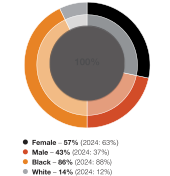
Merafe employees (gender and race)
The Venture provides full-time adult education and training for its employees and portable skills training that equips employees for careers beyond the Venture.
The venture invested
R243.6 million
in skills development
(2024: R289.72 million)The venture invested
R62.46 million
in artisan and other learnerships
(2024: R78.15 million)The venture invested
R159.86 million
in other Training and Development Initiatives
(2024: R181.75 million)An overage of
R24 663.83
was invested in training for each member of the Venture’s workforce (employees and contractors)
(2024: R30 605.97)684 631
Venture total training hours
(2024: 564 609)65.47
average training hours per permanent employee
(2024: 50.81)261 242
training hours for contractors
(2024: 243 975)76.61
average training hours per external contractor employee
(2024: 57.5)The venture invested
R21.29 million
in bursaries, scholarships, AET and community training
(2024: R29.82 million)
Both Merafe and the Venture are committed to meeting their human resource development targets and retaining and developing their skilled employees.
The Venture provides:
It continually evaluates its training methods and best communication practices with the various age groups and cultures in its workforce.
The Venture invites senior managers whom it has identified as having leadership potential to participate in leadership programmes at universities. The Venture also provides them with additional training, support and career development opportunities. A total of 76% (2024: 88%) of junior leaders who attended a programme to enhance their supervisory skills were HDSAs. A total of 86% middle management employees participating in management level programmes were HDSAs.
Development of staff was a key focus in 2025 across all sites. Increased focus on computer-based training made training more efficient and structured.
| 2025 | 2024 | |
| Total training hours | 684 631 | 564 609 |
| Total training hours for permanent employees | 423 389 | 320 634 |
| Average training hours per permanent employees | 65.47 | 50.81 |
| Total training hours for contractors | 261 242 | 243 975 |
| Average training hours per contractor | 76.61 | 57.5 |
| Number of workers trained in health issues | 6 903 | 7 530 |
| Number of workers trained in safety issues | 15 859 | 21 059 |
| Number of workers trained in human rights issues | 14 116 | 16 591 |
| Number of workers trained in environmental training sessions | 10 717 | 11 774 |
| Community health training | 171 | 197 |
| Community environmental training | 150 | 166 |
| Community human rights training | 173 | 187 |
The total workforce of the Venture by employment type can be seen here.
See the table our approach to governance of this report for detail on the structure of the Venture’s Joint Board and top management where executives of Glencore and Merafe are members.