
Merafe Resources Limited
INTEGRATED ANNUAL REPORT
2025
Delivering today. Investing in tomorrow.
The Remuneration Report is presented in accordance with King IV and with the Companies Amendment Act 16 of 2024 (Companies Amendments Act). A glossary of terms used in this report is contained in our online Integrated Annual Report of 2025, which is on our website. If you are unable to access the online report please note the following key references used: “Policy” or “policy” means the remuneration policy of the Company; the “Company” or “Merafe” means Merafe Resources Limited and its wholly-owned subsidiary; the “Committee” means the Remuneration and Nomination Committee of the Company; the “Board” means the board of directors of the Company; “executive directors” and “nonexecutive directors” means executive and/or non-executive directors of the Company; the “CEO” means the Chief Executive Officer of the Company; and “FD” means the Financial Director of the Company.
The report is presented in three parts:
Actions taken by the Committee during the year and proposed changes for 2026
The Committee focused on the following key areas in 2025:
The Committee conducted a detailed review of the remuneration policy during the year to ensure that the policy is aligned with developments in best practice, legal and regulatory requirements as well as being competitive, and aligned to shareholder performance and other stakeholder interests.
Several updates to the remuneration policy, particularly in respect of the long-term incentives (LTI), were identified and are proposed for implementation for 2026 in the remuneration policy section of the Remuneration Report. The implementation of an executive minimum shareholding requirements (MSR) policy and enhancements to the malus and clawback policy are also proposed for implementation in 2026 as detailed further in the remuneration policy section of this report.
The Committee, in 2026, will also ensure compliance with sections of the Companies Amendments Act, which are likely to be implemented in 2026. These include key changes for public companies and state-owned entities including:
Remuneration Consultants
Bowmans conducted a review of the remuneration policy during the year. The Committee is satisfied that its advice was independent and objective.
Statement of voting at annual general meeting
The AGM of the Company for the financial year ended 31 December 2024 was held on 13 May 2025 and the requisite ordinary resolutions of a non‑binding advisory nature endorsing the policy and the Remuneration Implementation Report were each passed by the requisite majority of shareholders, as a result no engagement with dissenting shareholders was required. The remuneration policy resolution (Ordinary Resolution 7.1) was passed by a 90.98% majority, with 68.71% of the Company’s shares being voted. The Remuneration Implementation Report resolution (Ordinary Resolution 7.2) was passed by a 90.98% majority, with 68.71% of the Company’s shares being voted. The special resolutions to approve non‑executive remuneration and remuneration for the Board committees for 2025 were passed by at least 99.57% of the votes.
The Company continues to engage with the Remuneration Report and the policy with its stakeholders.
Statement on achievement of objectives
The Committee is satisfied that the remuneration policy achieved its objectives in 2025.
Remuneration philosophy, strategy and policy
The Company’s guiding philosophy is to employ high‑calibre, high‑performing employees who subscribe to the values and culture of our Company. We recognise that our employees are integral to the achievement of our corporate objectives and they are accordingly remunerated for their contribution and the value which they deliver.
Our Company is committed to fair, responsible and transparent remuneration across the business in respect of all employees on all levels. Both the fixed and variable elements of remuneration aim to support Company performance and value creation in the short, medium and long‑term, as well as to support the achievement of strategic objectives within the Company’s risk appetite.
This policy applies to all employees of the Company.
Our remuneration strategy and policy are reviewed at least annually by the Committee to ensure that they are appropriate and relevant in the support of sustainable business performance and in promoting an ethical culture and responsible corporate citizenship.
Our remuneration strategy is designed to be aligned with our business strategy and the execution thereof to promote positive outcomes.
Since we strive to attract, retain, motivate and reward employees for executing our business strategy, their remuneration must clearly be market‑related and independent third parties are used by the Committee for the purpose of benchmarking to the appropriate segment. The general principle of our remuneration strategy is to structure executive and employee remuneration to include:
The remuneration strategy and policy are communicated to all employees during the year, together with our expectations around their contribution to the success of our organisation.
The key principles of the policy are that:
Responsibility for the reward strategy rests with the Board, which in turn appoints the Committee. The Committee comprises at least three members, the majority of whom are independent non‑executive directors and is governed by formal terms of reference.
The terms of reference clearly deal with, inter alia, matters such as:
The primary role of the Committee is to ensure that the Company’s directors and senior executives are fairly rewarded for their individual contributions to the Company’s overall performance. The Committee also aims to ensure that remuneration is appropriate to attract, retain and motivate the right calibre of directors and senior executives who will strive to achieve the overall goals of the Company. The Committee must demonstrate to all stakeholders that the remuneration of senior executives is set by a committee of Board members who:
The Committee is responsible for making recommendations to the Board on the remuneration policy for directors and, to the extent that it deems necessary, makes comparisons between remuneration packages currently available to the Company’s own executive directors and those available to directors of other companies of a similar size in the comparable industry. Comparisons are also made with other companies in South Africa and, if relevant, internationally.
The Committee also takes into account a number of principles, being, inter alia:
Statement of fair, responsible and transparent remuneration
The Board approves a policy that articulates and gives effect to its direction on fair, responsible and transparent remuneration.
The policy for the remuneration of executive directors and other senior management is set by taking appropriate account of remuneration and employment conditions of the industry, the Venture and the Company’s specific circumstances.
The policy is governed by the Committee, which regularly reviews the policy to ensure that it is relevant and supports the Company’s strategy. To this end, see key principles under remuneration policy of this report.
Executive pay mix is defined as the balance targeted between the major components of executive remuneration, namely:
Note: Expected value is defined as the present value of the future reward outcome of an offer, given the targeted future performance of the Company and of its share price. It should not be confused with the term “fair value” which is used when establishing the accounting cost for reflection in a company’s financial statements. Neither should it be confused with the term “face value” which is used to define the current value of the underlying share at the time of an offer.
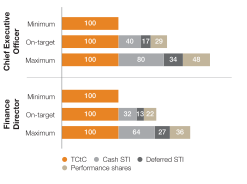
The remuneration policy for the 2025 financial year for the CEO and the FD is illustrated below for minimum, on-target/ expected, and maximum performance outcomes.
Executive pay mix (%)

Note: The maximum value illustrated above excludes movement in the share price.
The Company’s targeted pay mix aims to align the incentives of the employees with the interests of shareholders. It is recognised that, through acquisitions and business combinations over time, there will always be some deviation from the targeted pay mix structure across the Company. However, the balance between TCtC, STI and LTI for executive directors is shown for illustrative purposes in the schematic above, at various performance levels. The pay mix for the CEO and FD for the 2026 financial year is included in the section below that describes the proposed changes for 2026.
Merafe aims to establish and maintain an integrated pay mix with pay levels that ensure that it is able to remain competitive, while managing costs.
Executive remuneration in respect of guaranteed pay is expressed in terms of TCtC.
An employee’s TCtC consists of the following elements:
Salaries are reviewed annually and the total remuneration at the policy pay mix is targeted at the median of the relevant market. The Company conducts benchmarking exercises at least every second year against appropriate benchmarks. The benchmark used is the median of the total reward for similar positions in similarly-sized listed companies. In the case of employees with critical skills, high performance and potential, their total remuneration may be positioned towards the upper quartile of the market.
The Committee has regard principally to companies in the South African market, which are of similar size, complexity and scope to the Company. The Committee also takes into account business performance, salary practices prevailing for other employees in the Company and, when setting individual salaries, the individual’s performance and experience in the role.
Although salaries are reviewed annually, the Merafe board of directors (Board) reserves the right not to grant increases should circumstances so dictate. In addition, benefits offered are also reviewed on an annual basis to ensure that employees’ needs are addressed fairly, and that schemes are cost effective, well governed and competitive.
Merafe’s annual incentives are aimed at rewarding a combination of both business and individual performance in order to support a Company-wide high performance. Financial and non-financial criteria as well as individual performance determine the distribution of the pool to individuals.
Incentive awards are at the discretion of the Board after due consideration of the Company and individual performance.
The Committee follows a less mechanistic approach in determining the bonus awards in order to reward outstanding performance more appropriately and to ensure that undue windfalls are mediated.
As indicated above, the incentive scheme performance measures are assessed by the Committee and these measures are determined by taking into account the Company’s financial and non-financial criteria as well as individual performance.
All STI awards are based on performance against, inter alia, the following measures:
Targets are set by the Board on an annual basis as determined by the Company’s strategy, business plan and operating conditions. Targets are set to ensure that performance is measured appropriately in accordance with a five-point rating scale. In addition, the Board will apply appropriate weights to measures in order to focus on behaviour and performance, related to the strategic focus for the performance period.
Although measures and targets are determined at the start of the performance period, the Board may revise these measures and targets should prevailing business conditions indicate this to be necessary or in response to any other changes in the operating environment. All such changes, which represent the discretionary aspect of the policy, will be disclosed on an annual basis.
As indicated above, individual performance is primarily assessed from a predetermined criteria of key performance areas or value drivers.
The selection of these is informed by the Company’s business plan.
These metrics are assessed against a five-point scale as follows:
| Rating | Description | Definition | |
| 1 | Poor | Indicates poor performance. All or most threshold targets not met. | |
| 2 | Needs improvement | Performance against target is fair - however, performance against key measures is below threshold or target. | |
| 3 | Satisfactory | Performance on target in respect of most or all measures. | |
| 4 | Good | Performance exceeds target on most or all measures. Has reached the stretched target on a number of key measures. | |
| 5 | Outstanding/ excellent | Significant outperformance. All stretched targets met or exceeded. |
The total cash STI pool is capped for the various categories of employees as set out below:
| Position | Maximum % of TCtC |
|
| Chief Executive Officer | 100 | |
|---|---|---|
| Financial Director | 80 | |
| Senior management | 60 | |
| Management | 50 | |
| Administrative staff | 30 |
The total pool for incentives that becomes available for distribution will not be exceeded at any time.
STI potential is benchmarked at the median of the relevant market.
The final incentive calculation is undertaken by aggregating the incentive claims of all participants and comparing this to the pool derived from Company performance.
The details of the determination of the STI for the reporting year are included in the Implementation Report.
Background
The purpose of the share incentive scheme is to serve as an incentive and reward to employees of the Company and its subsidiaries for services rendered and to be rendered, aimed at promoting the continued growth of the Company by giving employees an opportunity to acquire shares in the Company and serve as a retention mechanism for employees whose services are regarded by the Company to be crucial to the future growth and sustainability of the Company’s business.
The share incentive scheme further seeks to align employee interests with those of shareholders and to support a culture of ownership, with a focus on Company performance and sustainable growth.
Long‑term incentives, in the form of a share incentive scheme, have been in existence in the Company since 1999. The current share scheme was approved by the Company shareholders on 22 May 2020, under which both share options and share grants may be issued.
All employees of the Company are eligible for share allocations in respect of the share incentive scheme rules, subject to Board approval and the prevailing implementation policy.
Under the rules of the share incentive plan, the following shares may be offered:
Generally, share options vest one‑third per year on the third, fourth and fifth anniversaries and are settled by physical delivery of shares against receipt of payment of the option price. The options lapse after seven years if not exercised by the participant, while the participant is in the employ of the Group.
Share grants are granted by the Board on the recommendation of the Committee. They vest one‑third per year on the third, fourth and fifth anniversaries and are settled by physical delivery of shares.
Alternatively, the Company has the right to settle the value of shares granted in cash.
Equity settlement will take the form of the purchase of shares on the open market for the benefit of the employee whose shares have vested. The Company reserves the right to issue new shares for purposes of settlement.
In the event of an employee leaving the Group for a reason approved by the directors, such as retirement or disability (no-fault terminations), all performance shares granted will vest, subject to the application of performance conditions. No pro‑rating of shares will apply. All approved terminations will be disclosed on an annual basis.
In the event of the death of an employee, all performance shares allocated will vest with no performance conditions or pro-rating applied.
In the event of either a no-fault termination or an employee’s death, the employee or his/her estate has 12 and 24 months, respectively, to exercise share options granted to that employee. In the event of retirement at the earliest date allowed by the retirement fund, the employee will have one year to exercise their allocated share options.
In the event of voluntary termination (i.e. resignation) or a fault termination (i.e. those who leave as a result of resignation, dismissal or poor performance), any right to any shares and all allocations will lapse immediately upon termination. No further claims may be laid to such lapsed shares, whether full value or share options.
In the event of a change in contract of employment, e.g. lateral moves or promotions, the participant will remain entitled to previous share allocations, subject to vesting periods, vesting schedules and prevailing performance conditions and criteria as set out during the initial share allocation.
In the event of a reconstruction or takeover, share allocations will vest on a pro-rata basis, subject to the Committee evaluating the applicable performance conditions and determining the number of shares per participant.
In 2018, the Committee revised the allocation policy for more share grants to be subject to performance conditions as opposed to retention shares, as illustrated below:
Revised LTI allocation policy
| Targeted offer value % of TCtC |
Balance performance/ retention |
||
| Chief Executive Officer | 60 | 100/0 | |
|---|---|---|---|
| Financial Director | 45 | 100/0 | |
| Senior management | 40 | 100/0 | |
| Management | 35 | 100/0 | |
| Administration | 25 | 100/0 |
Since 2018, all share allocations are performance-based. In order to balance back to the reward mix and expected outcomes, the targeted value of the share allocation as a percentage of TCtC was increased as per the table above.
The performance conditions for all existing performance‑oriented share grants will remain in place, but the 2025 grants are governed by two metrics:
The Committee will assess performance against the target once the applicable performance period is completed and approve the vesting of performance shares to the extent that targets are met.
The comparator group for TSR is made up as follows:
TSR comparator group
| Company | Ticker | |
| Thungela Resources Limited | TGA | |
| Harmony Gold Mining Limited | HAR | |
| Pan African Resources plc | PAN | |
| Merafe Resources Limited | MRF | |
| Tharisa plc | THA | |
| MC Mining Limited | MCZ | |
| DRDGOLD Limited | DRD | |
| Wesizwe Platinum Limited | WEZ | |
| Hulamin Limited | HLM | |
| African Rainbow Minerals | ARI | |
| Northam Platinum Holdings Limited | NPH | |
| Southern Palladium Limited | SDL |
Vesting of the performance-based share grants will be in accordance with the following policy:
The table below provides details of the vesting schedule for performance shares subject to the TSR measure:
Vesting schedule TSR
Vesting schedule over three years – TSR
| Merafe TSR position/ranking relative to peers | Vesting quantity % of allocation* |
|
| Position 1 – 4 | 100 | |
|---|---|---|
| Position 5 | 66.6 | |
| Position 6 | 33.3 | |
| Position 7 and lower | 0 |
| * | Vesting over three years in equal portions. |
Assuming that the performance targets below are set by the Board as illustrated in the table below, vesting of the performance-based share grants will be in accordance with the following policy:
Vesting schedule for Growth in HEPS measure
Vesting schedule over three years – growth in HEPS
| HEPS target | Vesting quantity % of allocation* proposed |
|
| On target CPI + 2% | 100 | |
|---|---|---|
| Threshold CPI + 1% | 50 | |
| Below threshold | 0 |
| * | Vesting over three years in equal portions. |
2025 LTI offer policy
The following principles will govern the LTI offer policy:
LTI policy updates for the 2026 financial year
LTI policy updates for the 2026 financial year (%)
| Measure | Weight | Threshold | Target | Stretch | |
| HEPS growth | 40% | < CIP +1% 0% vesting |
CPI +1% 50% vesting |
CPI +2% and greater 100% vesting | |
| TSR | 30% | Position 6 33% vesting with 0% from 7 and above |
Position 66% vesting | Position 1–4 100% vesting |
|
| Operating cash flow/revenue | 20% | 8% 0% vesting |
15% 70% vesting |
20% 100% vesting |
|
| Safety – TRIFR | 10% | 3.20 | 2.56 | 2.13 | |
| 0% vesting | 70% vesting | 100% vesting |
Contracts of employment
Senior and executive management are subject to the Company’s standard terms and conditions of employment where notice periods are between three and six months. In line with the recommendations set out in the King IV Report, Company policy precludes any senior or executive manager from being compensated for loss of office.
In the event of a change of control of the Company (as defined in the Companies Act) where the Company no longer requires an executive to fulfil their specific role post the change of control, the Company shall pay to the executive 12 months’ remuneration on the last day of the notice period and after completion of handover of duties, for existing executives as at 2019. From 2020 onwards, all newly appointed executives will have their termination payments aligned with their contractual notice period.
Retention measures
The Committee reserves the right to apply retention measures should circumstances indicate. Retention measures may include cash or equity awards and will be appropriately disclosed on an annual basis.
Malus and clawback
Any remuneration previously paid to executive directors that is subsequently found to have been the result of criminal or otherwise illegal activities, must be repaid to the Company.
In the event of restatement of the Company’s results (other than a restatement caused by a change in accounting policy, standards or interpretation), which results in lower performance-based remuneration calculated on the restated results, the Committee shall review such performance-based remuneration, determine the amount to be recovered from the executive and take steps to recover the amount.
The Board reserves the right to cancel any share allocation for all or individual participants if, during the vesting period, there is evidence of serious underperformance or misrepresentation of information, e.g. gross negligence, overstatement of performance, unnecessary risk taking, poor governance and non-compliance.
Minimum Shareholding Requirements
The members of the Executive Committee are subject to a MSR policy, where they are required to build up personal holdings of Company shares over a period of six years to the value of:
The executives may build up these holdings from their own resources or from STI before they accrue, or long-term incentive awards that they commit to hold. The executives will have a period of six years to build up the target holdings starting from 1 January 2026, for incumbent members of the Executive Committee, or six years from the date of appointment to the Executive Committee for new members. Unvested long-term incentive awards are not considered for this purpose. The share price used to assess the value of the holdings will be set to the original acquisition price for own holdings, or to the five-day volume weighted average price on the commitment date for long-term incentive shares.
Non-executive directors’ fees
The remuneration of non-executive directors is provided in the context of good governance, and is primarily based upon a methodology which takes into account expertise, contribution by the director and meeting attendance.
Standard duties of non-executive directors include preparation for and attendance at Board meetings, annual general meetings and results presentations. If required, the directors may be requested to perform work outside of their standard duties and for this they will be remunerated based on the time spent and their level of expertise. Non-executive directors’ pay is aimed at aligning with remuneration principles applicable to executive pay.
Independent benchmarks are conducted at least every second year to inform the levels of remuneration for non-executive directors and the intent is to target remuneration at the median quartile (50th percentile) of listed companies of a similar size (comparator or peer group), in order to ensure that appropriately qualified and experienced directors are appointed.
Non-executive directors’ fees are tabled for approval by the shareholders of the Company on an annual basis. The fees paid to non-executive directors for different roles such as the Chairperson may vary from the fees paid to other non-executive directors. Fees are split between a retainer (60%) and per meeting fee (40%), which is aligned with industry practice.
Non-executive directors will not participate in any share-based incentive scheme or any other incentive scheme that the Company may implement, to avoid any potential conflict of interest.
Review
This policy was approved by the Company in March 2026 and will be reviewed annually against current legislation and practice for a non-binding advisory vote by shareholders during the AGM.
In the event that either the remuneration policy or the Implementation Report, or both, are voted against by 25% or more of the votes exercised at the AGM, Merafe undertakes to engage with dissenting shareholders to understand their concerns.
The implementation of the policy approved by shareholders at the annual meeting in May 2025 is set out below:
| 2025 R’000 |
2024 R’000 |
||
| Z Matlala | |||
| Salary | 6 508 | 6 083 | |
| Bonus | 4 889 | 6 101 | |
| Fringe benefits | 68 | 272 | |
| Provident contributions | 1 046 | 932 | |
| Share grants vested | 6 797 | 9 345 | |
| Total | 19 308 | 22 733 |
| 2025 R’000 |
2024 R’000 |
||
| D Chocho | |||
| Salary | 4 456 | 4 227 | |
| Bonus | 2 645 | 3 301 | |
| Fringe benefits | 117 | 612 | |
| Provident contributions | 653 | 401 | |
| Share grants vested | 2 941 | 4 033 | |
| Total | 10 812 | 12 574 |
The executive directors were assessed by the Committee according to the table set out below which was then used as a basis for awarding bonuses for 2025.
| Key factors | Key measurement items | |
| Profitability | EBITDA compared to budget and previous years | |
| Growth of business | Growth assets and revenue | |
| Cost management | Effective cost management at Venture’s and Merafe levels | |
| Sustainability | B-BBEE rating to amended scorecard, CSI, environmental incidents | |
| Safety | TRIFR, fatalities | |
| Stakeholder engagement | Stakeholder engagement programme including interactions with SARS, partners, shareholders, employees, etc. | |
| Talent management | Succession planning, managing employees, training, mentoring. | |
| Reporting | Interim and annual reporting |
As per the policy, the Committee applied a less mechanistic and more holistic approach, which has resulted in the following bonus allocation. In addition, the net profit after tax used to determine the cap for the STI pool has been normalised by disregarding the provision for impairments for the financial year, because these are non-recurring, unusual expenses.
| 2025 % allocation of cost to Company |
2024 % allocation of cost to Company |
||
| Chief Executive Director | 62 | 81 | |
|---|---|---|---|
| Financial Director | 49 | 65 |
As at 31 December 2025, the directors of the Company are beneficially interested (directly and indirectly) in 3 553 565 (31 December 2024: 3 553 565) shares in the Company. During the financial year, no material contracts were entered into in which directors and prescribed officers of the Company had an interest and which significantly affected the Group.
Executive directors of the Company and their immediate families control 0.14% (31 December 2024: 0.14%) of the voting shares of the Company. In addition to their salaries, the Company contributes to a provident fund (defined contribution plan) and medical aid fund on their behalf. Executive directors also participate in the Company’s share incentive scheme.
| 2025 Number of shares | 2024 Number of shares | ||||
| Direct | Indirect | Direct | Indirect | ||
| Z Matlala | 2 945 000 | – | 2 945 000 | – | |
|---|---|---|---|---|---|
| D Chocho | 608 565 | – | 608 565 | – | |
| Total | 3 553 565 | – | 3 553 565 | – | |
No additional directors’ interests have been noted post 31 December 2025 until the date of approval of this report, being 6 March 2026.
The awards of LTIs under the Company’s share option and grant schemes are set out below:
Cash-settled share-based payment arrangements
The following share grants relating to executive directors were outstanding at 31 December 2025:
| Vesting date | Z Matlala Number of Shares |
D Chocho Number of Shares |
|
| 1 April 2026 | 1 618 480 | 698 538 | |
|---|---|---|---|
| 1 April 2026 | 709 641 | 324 299 | |
| 1 April 2026 | 1 006 647 | 460 027 | |
| 1 April 2027 | 709 641 | 324 299 | |
| 1 April 2027 | 1 006 647 | 460 027 | |
| 1 April 2027 | 910 671 | 461 946 | |
| 1 April 2028 | 1 006 647 | 460 027 | |
| 1 April 2028 | 910 671 | 461 946 | |
| 1 April 2028 | 1 259 003 | 638 640 | |
| 1 April 2029 | 910 671 | 461 946 | |
| 1 April 2029 | 1 259 003 | 638 640 | |
| 1 April 2030 | 1 259 003 | 638 642 | |
| Total | 12 566 726 | 6 028 978 |
Performance conditions
The performance conditions are set out above.
Share grant allocations were implemented based on the VWAP of the previous day’s trading as follows:
| 2025 | 2024 | ||||||
| % allocation of cost to Company | Number of shares |
Vesting period |
% allocation of cost to Company | Number of shares |
Vesting period |
||
| Chief Executive Officer | 60 | 3 777 009 | 1 April 2028 1 April 2029 1 April 2030 |
60 | 4 316 582 | 1 April 2027 1 April 2028 1 April 2029 |
|
|---|---|---|---|---|---|---|---|
| Financial Director | 45 | 1 915 921 | 1 April 2028 1 April 2029 1 April 2030 |
45 | 2 189 624 | 1 April 2027 1 April 2028 1 April 2029 |
|
| Note: | As per the policy, from 2019, 100% of the grants are subject to performance conditions for the CEO and FD, respectively. |
The non-executive directors’ fees for 2025, which were approved at the AGM by the requisite 75% majority of shareholders, are set out below:
| 2025 | |||||||
| Total fees per annum R |
Retainer 60% R |
Monthly retainer fees R |
Retainer per quarter R |
Fees per attendance 40% R |
Fees per attendance per meeting R |
||
| Board Chairperson | 903 596 | 542 158 | 45 180 | 135 539 | 361 438 | 90 360 | |
|---|---|---|---|---|---|---|---|
| Board Member | 350 404 | 210 242 | 17 520 | 52 561 | 140 162 | 35 040 | |
| Audit and Risk Committee Chairperson | 256 676 | 154 005 | 12 834 | 38 501 | 102 670 | 25 668 | |
| Audit and Risk Committee Member | 160 955 | 96 573 | 8 048 | 24 143 | 64 382 | 16 095 | |
| Remuneration and Nomination Committee Chairperson | 172 729 | 103 637 | 8 636 | 25 909 | 69 092 | 23 031 | |
| Remuneration and Nomination Committee Member | 105 434 | 63 260 | 5 272 | 15 815 | 42 174 | 14 058 | |
| Social, Ethics and Transformation Committee Chairperson | 159 935 | 95 961 | 7 997 | 23 990 | 63 974 | 21 325 | |
| Social, Ethics and Transformation Committee Member | 105 434 | 63 260 | 5 272 | 15 815 | 42 174 | 14 058 | |
Non-executive directors’ fees paid for 2025
| Retainer 2025 R |
Attendance 2025 R |
Total 2025 R |
Total 2024 R |
||
| Ms. M Vuso | 364 248 | 347 953 | 712 201 | 578 171 | |
|---|---|---|---|---|---|
| Mr. J Mclaughlan | 313 880 | 314 375 | 628 255 | 498 222 | |
| Mr. K Tlale | 306 816 | 309 665 | 616 481 | 487 009 | |
| Ms. N Mabusela-Aikhuere | 402 776 | 373 639 | 776 415 | 605 956 | |
| Mr. S Phiri | 668 679 | 716 865 | 1 385 544 | 796 716 | |
| Mr. D McGluwa* | 273 503 | 154 220 | 427 723 | 400 760 | |
| Mr. D Green** | 273 503 | 287 457 | 560 960 | 434 132 |
| * | Paid to IDC. |
| ** | Paid to GOSA. |
See the online 2025 Integrated Annual Report and the annual financial statements for additional and supporting information.
Non-executive directors’ fees proposed for 2026
The 2026 proposed fees, exclusive of VAT, in accordance with the policy, are set out below and result in an overall increase of 5% from the previous year. This increase and the allocation take into account the previous benchmarking exercise and inflation.
| 2026 | |||||||
| Total fees per annum R |
Retainer 60% R |
Monthly retainer fees R |
Retainer per quarter R |
Fees per attendance 40% R |
Fees per attendance per meeting R |
||
| Board Chairperson | 948 776 | 569 265 | 47 439 | 142 316 | 379 150 | 94 878 | |
|---|---|---|---|---|---|---|---|
| Board Member | 367 924 | 220 755 | 18 396 | 55 189 | 147 170 | 36 792 | |
| Audit and Risk Committee Chairperson | 269 510 | 161 706 | 13 475 | 40 426 | 107 804 | 26 951 | |
| Audit and Risk Committee Member | 169 003 | 101 402 | 8 450 | 25 350 | 67 601 | 16 900 | |
| Remuneration and Nomination Committee Chairperson | 181 365 | 108 819 | 9 068 | 27 205 | 72 546 | 24 182 | |
| Remuneration and Nomination Committee Member | 110 706 | 66 423 | 5 535 | 16 606 | 44 282 | 14 761 | |
| Social, Ethics and Transformation Committee Chairperson | 167 932 | 100 759 | 8 397 | 25 190 | 67 173 | 22 391 | |
| Social, Ethics and Transformation Committee Member | 110 706 | 66 423 | 5 535 | 16 606 | 44 282 | 14 761 | |
Areas of focus for 2026
Key activities for the Committee in 2026 will be, inter alia, the approval of the remuneration and bonuses for executive directors and senior management. In addition, the Committee will review King V on areas pertinent to its activities, monitor if certain aspects of the Companies Amendment Act become effective and review its terms of reference in the light of the above.
The Committee will also assess fees to be paid to non‑executive directors. Focus will be placed on the key principles of King V and the Company’s commitment to these principles and reviewing the remuneration policy. In addition, the Company will, if required, engage with shareholders to discuss issues of mutual concern.
Compliance statement
The Board and the Committee are committed to maintaining high standards of corporate governance and to support and apply the principles of good governance advocated by the Institute of Directors South Africa (IoDSA) and King IV, and going forward, King V.
The Board and the Committee are of the view that the objectives stated in the policy have been achieved for the period under review. The Board and the Committee are also satisfied that they have fulfilled their responsibilities in accordance with their terms of reference with regard to remuneration within the Company.
JEFF MCLAUGHLAN
Chairperson – Remuneration Committee
6 March 2026

